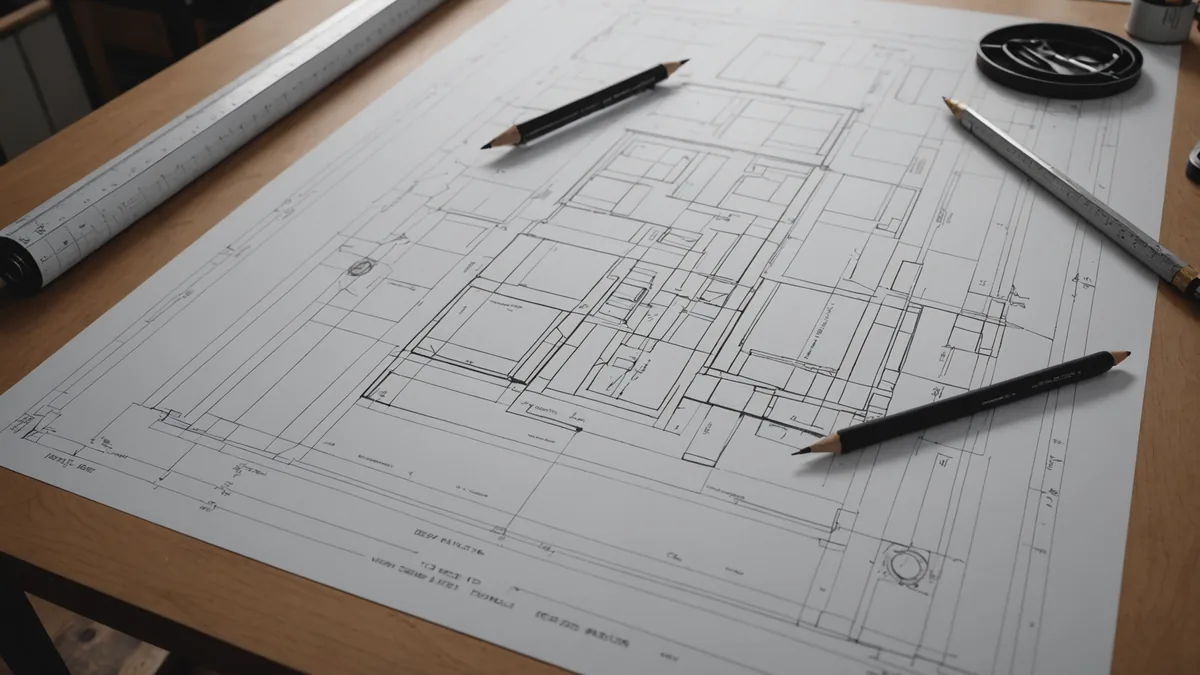
A commercial electrical permit submission is not just a collection of drawings. Plan review authorities evaluate whether the submitted set, taken as a whole, demonstrates that the proposed installation will comply with the adopted code and that it can be inspected efficiently in the field. This distinction matters because engineering firms sometimes conflate technical accuracy with permit-readiness. A drawing can be technically correct and still fail plan check if it lacks the specific items a plan checker needs to verify compliance.
The Drawing Set Plan Review Actually Evaluates
Most jurisdictions require a minimum set of documents for commercial electrical review: a single-line diagram showing the service and distribution system, panel schedules for each distribution panel and motor control center, load calculations supporting the service size and feeder sizing, a riser diagram showing vertical distribution of feeders and panels, and a site plan with the service entrance location marked. Some authorities having jurisdiction (AHJs) also require arc flash study data for projects above a certain service voltage or when working on energized equipment is anticipated. The exact requirements depend on the adopted code cycle and any local amendments.
The drawing index or cover sheet matters more than engineers typically expect. Many AHJs use intake review to confirm all required sheets are present before assigning the submission to a plan checker. If the index does not list every required sheet, the submission may be rejected at intake before it reaches technical review. That rejection adds at least a week to the timeline and does not count as the jurisdiction's review clock.
What Reviewers Look for First
Plan review staff typically go to the single-line diagram first. They check whether the available fault current is listed at the service entrance, whether overcurrent device ratings and interrupting capacities are shown, and whether the service disconnect ampacity matches the load calculation. These three items are verifiable in under five minutes and flag the largest share of correction-worthy problems in a drawing set.
Panel schedules get checked against the load calculation totals. If the connected load on panel schedules does not align with the demand load calculation on the load summary sheet, that discrepancy generates a correction comment. The same applies to feeder sizing: if a feeder shown on the single-line diagram is smaller than what the load calculation requires under NEC Article 220, the reviewer will flag it.
Riser diagrams are checked for conductor sizing, conduit type, and panel designations that match the single-line. A riser that uses panel designations inconsistent with the panel schedules is a common source of back-and-forth comments that add weeks to a review cycle. The cross-referencing burden lands on the reviewer, and reviewers in high-volume offices do not spend time resolving inconsistencies that should have been caught before submission.
The Most Common Gaps That Trigger Corrections
Missing or incomplete load calculations account for a large share of correction items across commercial submissions. The calculation must address all loads on the premises, apply appropriate demand factors per Article 220, and show a connected load total that justifies the service size. Calculations that skip lighting loads, omit future expansion provisions, or fail to identify the calculation method (standard vs. optional) get flagged.
The second most common gap is missing fault current data. Most AHJs require the available short-circuit current at the service entrance to be shown on either the single-line diagram or a separate fault current study sheet. Without this, the plan reviewer cannot verify that overcurrent devices have adequate interrupting capacity. The value must come from the serving utility, and the drawing should note the utility source and voltage.
The third category is panel schedule errors: mismatched phase assignments, total connected loads that exceed panel bus ratings, or missing neutral and ground bus sizing. These errors indicate the panel schedule was produced independently from the load calculation rather than derived from it. Panel schedules should be the output of the load calculation, not a parallel document assembled from different sources.
Code Adoption Matters More Than You Think
The National Electrical Code is published every three years, but adoption by state and local jurisdictions is uneven. As of mid-2026, some major jurisdictions still enforce NEC 2017 or 2020 while others have adopted NEC 2023. The adopted cycle affects which specific article requirements apply to a given project. An engineer submitting in a jurisdiction on NEC 2020 who applies NEC 2023 requirements for surge protective devices under Section 230.67 may be citing a section that is not yet in force locally, which creates confusion in the plan check comment.
Before producing a drawing set for any jurisdiction, verify the adopted code cycle and any local amendments. Many AHJs post this information on their building department website or on the permit application form. Local amendments sometimes add requirements beyond the base NEC: certain California jurisdictions have Title 24 electrical requirements that run parallel to the NEC and must be reflected in the drawings independently.
Reviewability vs. Technical Correctness
A drawing set can be technically correct and still fail to get approved quickly if it is not reviewable. Reviewability means the drawings are organized logically, referenced consistently across sheets, use standard notation conventions, and answer the questions a plan checker is trained to ask in the order they ask them.
This is not a call for all drawing sets to look the same. It is a call for the information a reviewer needs to be findable without a prolonged search. When a panel schedule total requires cross-referencing four other sheets to verify, or when the single-line uses notation that does not appear in a legend, review time increases and the probability of a correction comment requesting clarification goes up.
The practical standard for permit-readiness combines two things that are sometimes treated as separate: a technically sound design that complies with the adopted code, and a drawing organization that lets a reviewer confirm compliance without friction. Producing both in the same submission is the difference between a single-round approval and a multi-round correction cycle.
We are not saying that every jurisdiction applies the same standards uniformly. Review quality and reviewer expertise vary substantially. But optimizing the drawing set for reviewability is the most reliable variable within an engineer's control, and it is the one that most directly affects whether a project hits its permit timeline.